
NEET Dropper Mental Health — The Complete Guide to Managing Anxiety, Burnout and Depression During Your Drop Year

There is something that happens in the third month of a drop year that nobody warned you about.
The motivation you started with in May — the fire, the clarity, the “this time I will do it differently” energy — begins to thin. Some days you sit at your desk for four hours and retain almost nothing. You watch your friends post college photos while you are still doing the same Biology chapter you did last year. A parent says something well-meaning about the exam and it lands like a judgment. You tell yourself this is normal, push through — and the weight just quietly keeps building.
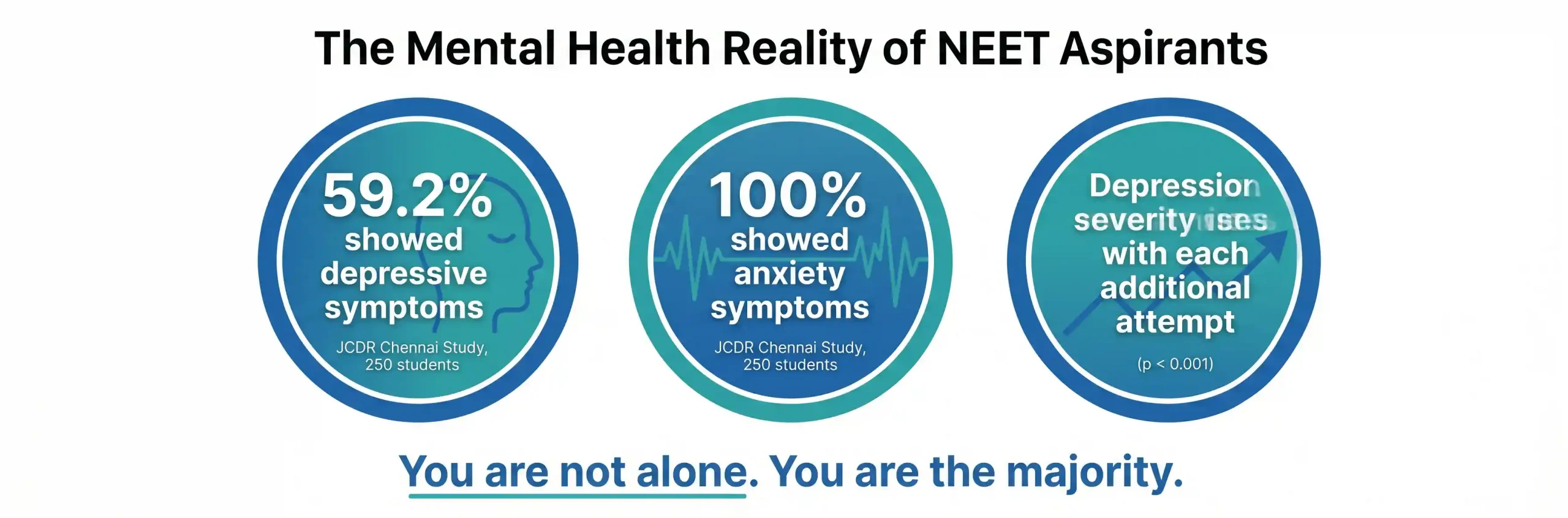
Here is what you need to know before anything else: a peer-reviewed study conducted across NEET coaching centres in Chennai found that 59.2% of NEET aspirants showed depressive symptoms, and 100% showed measurable anxiety symptoms. Every single student in that study had anxiety. Not some. All of them. A separate study found that 33.3% of NEET students showed depression symptoms, with the rate rising significantly with each additional attempt.
You are not weak. You are not failing. You are a human being carrying one of the heaviest academic and emotional loads in India’s education system — and the weight is real, documented and understood.
This guide exists because understanding what is happening inside your mind is the first step to managing it. Not with platitudes. Not with “stay positive.” With specific, practical, science-grounded tools that work — even when the drop year gets hard.
The Data Nobody Shares With You — How Serious Is NEET Mental Health?
Most coaching centres treat student mental health as a footnote — a paragraph at the end of the study plan that says “take care of yourself.” The research tells a very different story.
What the Research Actually Shows About NEET Aspirants and Mental Health
Across multiple studies conducted on Indian NEET students, the pattern is consistent and alarming.
In the Chennai study published in the Journal of Clinical and Diagnostic Research, all 250 students studied showed anxiety symptoms — 44.64% at moderately high to high levels. Depressive symptoms were present in 59.2% of participants. These were not students in crisis — they were regular coaching centre students, sitting in classrooms every day, appearing completely functional from the outside.
A separate cross-sectional study across NEET coaching centres found that 53% of students showed anxiety and 44% showed depression — with rates significantly higher among students from rural backgrounds and those appearing for multiple attempts. Another study measuring JEE and NEET students together found that 35% reported a complete loss of motivation and 66.7% showed signs of emotional distress from irregular sleep and long study hours.
What this means for you practically: if you are struggling emotionally during your drop year, you are not an exception. You are the majority. The student next to you in the coaching centre who appears fine is almost certainly carrying the same weight behind closed doors. The difference between students who manage it and students who are crushed by it is not emotional strength — it is whether they have a system for recognising and addressing what they are going through.
Why Droppers Are More Vulnerable Than First-Time Students
The Chennai study found something specific and important: the severity of both anxiety and depression rose significantly with the number of previous NEET attempts, with a statistically significant association at p-value less than 0.001. In plain terms: every additional attempt adds measurable psychological burden.
This makes sense when you think about what a dropper carries that a first-time student does not. A first-time student has the psychological protection of no prior failure — the exam is still hypothetically winnable. A dropper has evidence of at least one attempt that did not go as planned, which the brain interprets as a signal of potential future failure. That interpretation — however inaccurate it may be — runs as a background process through every study session, every mock test and every moment of difficulty. It does not switch off on its own. It has to be addressed directly.
Four Mental States — Which One Are You In Right Now?
This is the section that makes the biggest practical difference — and the one no competitor blog includes.
“Stress,” “burnout,” “anxiety” and “depression” are four different things. They feel different, they come from different sources and they respond to different interventions. Using the same approach for all four is like taking a fever pill for a broken bone — same general category of “something is wrong,” completely wrong solution.
Read each description below slowly. Be honest with yourself about which one fits your current experience — or whether you are moving between more than one.
Normal Exam Stress — Useful, Manageable, Expected
Normal exam stress is the body’s response to a high-stakes situation it wants to do well in. It shows up as tension before a mock test, restlessness when you are behind on a topic, mild irritability on difficult study days.
The key quality of normal stress is that it comes and goes. You feel it before the mock and it releases after. You feel it when you miss a study target and it eases when you get back on track. It responds to action — do the work, and the stress reduces. It does not follow you into sleep, it does not flatten your personality and it does not make you feel like nothing matters.
Normal stress is not a problem to solve. It is a signal that you care, and caring is what makes you study. The goal is not to eliminate it — it is to keep it at a level where it sharpens your focus rather than overwhelming it.
What helps: The daily routine in Section 4 of this guide. Structure is the best regulator of normal stress.
Burnout — When Exhaustion Becomes Numbness
Burnout is what happens when stress has been sustained for too long without adequate recovery. The brain and body, having been asked to perform at high intensity for months, simply begin to shut down non-essential functions.
Think of it like a phone that has been running demanding apps continuously for 12 hours. It does not crash — it just gets slower and slower, the screen dims, nothing responds as quickly as it should. Burnout feels exactly like that.
The signs are specific and recognisable:
You used to find Biology interesting — now opening the textbook feels like lifting a weight. You sit at your desk for three hours and produce nothing, not because you are distracted but because there is nothing left to give. You sleep more than usual and wake up still tired. You stop caring about your mock score — not as a healthy detachment, but as a flat numbness where nothing feels worth the effort. Small things — a parent’s comment, a friend’s message — provoke disproportionate irritability because your emotional reserves are simply empty.
The critical difference between burnout and normal stress: stress responds to action. Burnout does not. When you are stressed, completing a chapter reduces the feeling. When you are burnt out, completing a chapter leaves you feeling nothing — or sometimes worse. If you push harder through burnout, it deepens. The only intervention that works for burnout is genuine rest — not a 20-minute break, but a deliberate 2–3 day step back with no study pressure followed by a very gradual return.
What helps: Mandatory rest period. Reduce daily hours to 4–5 for one week. Remove study guilt completely during that week. See Section 4 for the full burnout recovery micro-protocol.
Anxiety — When Worry Takes Over the Thinking Brain
Anxiety is a specific neurological state where the brain’s threat-detection system — the amygdala — becomes chronically overactivated. It stops responding proportionally to actual threats and starts firing at perceived or imagined ones.
The result is a mind that cannot stop running worst-case scenarios. What if I fail again? What if my score does not improve? What will my family say? What happens to my future? These thoughts are not insights — they are your threat-detection system running on a loop, consuming cognitive resources that should be available for studying and problem-solving.
Anxiety feels different from normal stress in a specific way: it is not anchored to a real, present problem. Stress says “I have not revised this chapter and the mock is tomorrow — I need to act.” Anxiety says “Everything is going to go wrong” — even when you are well-prepared, even when the exam is two months away, even when there is no specific problem in front of you.
The physical signs are equally identifiable: tightness in the chest before sitting down to study, nausea on mock test mornings, difficulty falling asleep because the mind will not stop, a racing heart when looking at a difficult question.
What helps: The box-breathing technique and thought-labelling practice in Section 4. These are not general wellness suggestions — they are specific techniques that interrupt the amygdala activation cycle. Consistent practice over 2–3 weeks measurably reduces baseline anxiety.
Depression — When It Goes Beyond Stress
Depression is different from all three states above in one essential way: it is not about the exam. A student experiencing depression is not primarily worried about NEET — they feel a pervasive flatness or sadness that exists independently of what is happening with their preparation.
The signs include: persistent low mood that does not lift even on good study days or after good mocks; withdrawal from people you normally enjoy being around; loss of interest in things that used to matter to you outside of NEET; changes in appetite or sleep that are not explained by study schedule; a sense of worthlessness or hopelessness that feels like a fact, not a feeling.
The important distinction: depression is not laziness, weakness or a study attitude problem. It is a clinical condition with a neurological basis — specifically, dysregulation of neurotransmitters including serotonin and dopamine that govern mood, motivation and pleasure. Pushing harder through depression does not work. Willpower does not correct neurotransmitter dysregulation. This is not a character flaw — it is a medical situation that deserves medical attention.
What helps: Section 5 of this guide covers when and how to seek professional support. If the signals described above have been present consistently for two or more weeks, please read Section 5 before anything else.
| Mental State | Core Experience | Duration Pattern | Responds To |
|---|---|---|---|
| Normal Stress | Tension tied to a specific task or event | Comes and goes with circumstances | Action — completing tasks, structured routine |
| Burnout | Numbness, flatness, exhaustion that rest does not fix | Builds gradually over weeks/months | Genuine rest + gradual recovery, not more work |
| Anxiety | Chronic worry, physical symptoms, racing thoughts | Persistent, not tied to specific events | Breathing techniques, thought-labelling, routine |
| Depression | Pervasive low mood, withdrawal, loss of meaning | Constant, does not lift with good events | Professional support — self-help has limits here |
Read More: Molecular Basis of Inheritance NEET 2026: Complete Notes, Experiments, PYQs, Common Mistakes and Topper Strategy
The 5 Pressure Sources That Drive Drop Year Mental Health Decline
Understanding where your stress comes from is not a therapeutic exercise — it is a practical one. When you know which pressure source is active, you can address that specific source instead of trying to manage an undifferentiated cloud of “NEET stress.” Research on Indian students shows that academic pressure, parental expectations and peer comparison collectively affect over 63% of students at measurable levels. These are not vague influences — they work through specific, identifiable mechanisms.
1. Parental Expectation Pressure
Two-thirds of Indian students in academic stress research report feeling pressure specifically from their parents to perform better — and this pressure is not simply about nagging. In a collectivist family structure like most Indian households, a child’s academic result is genuinely intertwined with family honour, financial planning and social identity. Parents are not being cruel when they apply this pressure — they are expressing love and fear in the only language the education system has given them.
The problem is neurological: research shows that perceived parental pressure increases test anxiety, which then mediates directly into reduced academic performance. In plain terms — when parental pressure increases your anxiety before a test, your test score drops even when your preparation is identical. The pressure intended to motivate actually damages the performance it is trying to improve.
What to do with this: You cannot change your parents’ feelings about NEET. You can change the information they have. Parents who understand what you are doing every day — your study schedule, your mock progress, your specific plan — apply significantly less anxiety-driven pressure than parents who are left to imagine how the preparation is going. One calm, factual weekly update (“I revised these chapters this week, my mock score moved from X to Y, my plan for next week is Z”) replaces 10 anxiety-fuelled conversations.
2. Peer Comparison and Social Visibility
Your friends who did not take a drop year are now in college — posting about orientation, hostels, new friendships and everything that looks like moving forward. You are in the same room you studied in last year, doing the same Biology chapter. The gap between those two realities, viewed through a phone screen every day, is one of the most psychologically corrosive experiences of the drop year.
Here is the reframe that is factually accurate and not just positive thinking: you and your college-going friends are on different timelines by choice, not by failure. They chose the path available after their Class 12 result. You chose a path that requires one additional year of investment in exchange for a specific career outcome. These are different choices — not a better path and a worse path. The brain does not naturally make this distinction when it is scrolling Instagram at 11 PM. Your job is to make it consciously.
3. Academic Load and Information Overwhelm
NEET covers 97 chapters across three subjects from Classes 11 and 12. The sheer volume of information the brain is being asked to hold, connect and retrieve on demand is genuinely extraordinary — and research confirms that information overload is a primary driver of the particular stress pattern seen in entrance exam students.
The drop year adds a layer: you have already seen this content once. That means you are not learning it fresh — you are trying to rebuild a structure that partially collapsed. Some chapters will feel familiar and fast. Others will feel like you are seeing them for the first time despite having studied them for months. Both experiences are normal. The brain encodes information in context — if the context of last year’s study environment was stressful and rushed, the encoding was shallow. This year’s slower, more deliberate rebuild actually creates better memory architecture.
4. Time Pressure and the Calendar
NEET exam day is fixed. As the months pass, the remaining preparation time visibly shrinks — and with it, a specific kind of time-urgency anxiety activates. This is different from general stress. It is the experience of watching a countdown you cannot stop, which activates the brain’s threat response even when your preparation is on track.
The practical fix: convert the time pressure from a countdown into a task list. “I have 8 months left” activates anxiety. “I have 8 months, which is 240 days, which means I can complete all 97 chapters with 2.5 days per chapter and still have 45 days for full revision” activates planning. Same time, completely different brain response.
5. Identity and Self-Worth Fusion
This is the most invisible and most damaging pressure source of all. Many droppers — particularly those who have been high performers in school — have fused their sense of self-worth with their academic performance so completely that a bad mock score is not just disappointing. It feels like evidence of who they are.
A bad mock becomes “I am not good enough.” A difficult chapter becomes “I am not smart enough.” A second drop year becomes unthinkable not because it is practically impossible but because the identity cannot absorb it. This pressure operates silently in the background of every study session, amplifying every difficulty and making recovery from setbacks much slower than it needs to be.
The key insight: your NEET rank will describe your performance on one paper on one day. It will not describe your intelligence, your worth or your future. Students who separate these two things — not because someone told them to, but because they genuinely examine the evidence and find the separation to be accurate — recover from bad mocks faster, study more calmly and perform better on exam day.
Your Daily Mental Health System — Practical, Non-Negotiable, 35 Minutes Total
Every technique in this section was chosen for one reason: it works within the reality of a NEET dropper’s day. Nothing here requires a therapist, an hour of meditation or a complete lifestyle overhaul. The total time investment is 35 minutes — split across morning, study time and evening.
The reason a daily system matters more than occasional self-care is this: mental health, like physical fitness, responds to consistent daily practice rather than intense but irregular effort. You cannot skip mental health maintenance for 6 days and compensate on the 7th any more than you can skip sleep for 6 days and compensate on the 7th. The system below is a daily drain on accumulated stress — small enough to do every day, consistent enough to actually work.
Morning — 10 Minutes
Do all three steps in order. Do not skip one because it feels unnecessary — each one activates a different part of the nervous system’s reset mechanism.
Step 1 — Physiological sigh (2 minutes)
This is the fastest evidence-based stress-reduction technique known. Take a double inhale through the nose — a full breath, then a second short sniff on top of it — followed by a long, slow exhale through the mouth. Repeat 5 times.
Why it works: The double inhale re-inflates the alveoli in the lungs that collapse during shallow stress breathing, and the long exhale activates the vagus nerve — the primary driver of the parasympathetic “rest and digest” system. This brings heart rate, cortisol and mental alertness into balance within 90 seconds. Research confirms it outperforms standard deep breathing in reducing acute stress.
Step 2 — Written intention (3 minutes)
Write one sentence in a notebook: “Today I will complete [specific task] and I will stop studying at [specific time].”
The first half activates directed focus. The second half is the part most students skip — and it is the more important part. A defined stop time prevents the open-ended “I must study until I have done enough” anxiety loop that causes chronic stress to build through the day. When the brain knows there is a finish line, it does not spend the entire day in low-grade panic about whether it is doing enough.
Step 3 — Natural light exposure (5 minutes)
Step outside or stand near an open window within 30 minutes of waking. Do not look at your phone during these 5 minutes.
Natural light in the morning sets the circadian rhythm that governs cortisol release, sleep quality and dopamine baseline throughout the day. A student who misses morning light and wakes to a phone screen disrupts this cycle — and will typically find concentration harder to achieve in the morning session and sleep harder to come by at night. Five minutes. Window or outside. No screen.
During Study — No Extra Time Required
These three adjustments happen within your existing study blocks. They do not add time — they change the quality of the time you are already spending.
The 50/10 rule with physical movement.
Every 50 minutes of study, stop for 10 minutes and move physically — a short walk, stretching, anything that involves your body moving through space. Not a phone scroll. Not a YouTube video. Physical movement.
The reason this matters neurologically: adenosine is a chemical that builds up in the brain during sustained cognitive work, creating the feeling of mental fatigue. Physical movement accelerates adenosine clearance while simultaneously releasing a brief pulse of dopamine and norepinephrine — both of which restore attention capacity. Students who do the 50/10 rule with physical movement consistently report being able to sustain 7–8 hours of quality study, whereas students who take passive phone-scroll breaks find quality dropping after 3–4 hours.
The confusion box.
Keep a small notebook section labelled “confusion box.” Every time you hit something that confuses you — a concept, a question, a mechanism you cannot follow — write it in the confusion box and move on. Do not stop to resolve it mid-session.
Come back to the confusion box at the end of the study day, when your mind is not in active learning mode. Most confusions resolve faster then than in the middle of a session, because the brain has had time to process them passively. More importantly, this technique prevents one confusing concept from derailing an entire study session and triggering disproportionate anxiety.
One-word emotional check-in.
Before each study block, write one word in the margin of your notebook describing how you feel: focused, anxious, tired, frustrated, calm. That single word takes 3 seconds and does something important: it moves the emotion from your subconscious background — where it quietly disrupts concentration without you realising it — to your conscious awareness, where it loses much of its power to interfere.
Evening — 25 Minutes
Progress journaling (10 minutes — 8:00 to 8:10 PM)
Write three specific things you completed or understood today. Not targets. Not aspirations. Evidence. “I completed the Nervous System revision and got 18 out of 20 questions right.” “I understood the SN2 mechanism today — finally.” “I studied for 7 hours without a major distraction.”
This is not positivity performance. It is a neurological correction for the negativity bias — the brain’s evolutionary tendency to register threats and failures more strongly than progress and success. Left unmanaged, the negativity bias means a student who has an objectively good study day still goes to sleep feeling like it was not enough. Progress journaling is a deliberate override. After 2–3 weeks of daily practice, the brain genuinely begins to register progress more clearly alongside gaps.
Wind-down protocol (15 minutes — 9:00 to 9:15 PM)
No screens for 15 minutes before sleep. This is not optional or aspirational — it is a physiological requirement. Screens emit blue-spectrum light that suppresses melatonin production for up to 90 minutes after exposure. A student who scrolls until 10:30 PM and tries to sleep at 10:45 PM is not actually allowing their brain to prepare for sleep — they are asking it to perform a function whose chemical precondition they just blocked.
Use the 15 minutes for: light non-study reading, a short walk, calm music, a quiet conversation. Any activity that does not involve a screen and does not involve NEET.
Burnout Recovery Micro-Protocol (use when you recognise burnout signals)
When you identify that what you are experiencing is burnout — not stress, not a bad day, but the numbness and flatness described in Section 2 — the following 3-day protocol is more effective than pushing through:
Day 1: Reduce study to a maximum of 3 hours of only light revision — no new content, no mocks. Sleep 8 hours. Do one physical activity outside.
Day 2: Maximum 4 hours study. Add one activity that has nothing to do with NEET and that you used to enjoy — music, cooking, a walk, a sport. This is not a reward. It is medicine.
Day 3: Return to 6 hours. Gradually rebuild to full schedule over the next 3–4 days.
Students who attempt to push through burnout without this recovery period typically extend their burnout from 3 days to 3 weeks. The 3-day protocol feels counterintuitive — studying less when you are behind feels like the wrong move. It is not. It is the only move that works.
When Self-Help Isn’t Enough — Recognising When to Seek Professional Support
Recognising that ceiling is not a sign of weakness. It is the same intelligence that tells you when a sprained ankle needs a doctor instead of just rest. The ankle and the mind both have conditions that respond to self-care, and conditions that require professional support. Knowing the difference is practical wisdom, not defeat.
The 5 Signals That Mean Professional Support Is Needed
Read each one honestly. If two or more have been consistently present for more than two weeks, Section 5 is the most important section of this entire guide for you right now.
Signal 1 — You cannot study despite genuinely trying.
Not laziness. Not distraction. You sit down, you intend to study, and something prevents you from starting or continuing — a heaviness, a blankness, an inability to engage that does not respond to any of the techniques in Section 4. This is the mind’s signal that the load has exceeded what behavioural strategies can manage alone.
Signal 2 — Sleep is consistently disrupted for more than two weeks.
Difficulty falling asleep, waking in the middle of the night with anxious thoughts, or sleeping far more than usual and still feeling exhausted — all of these, when persistent across two weeks, indicate that the nervous system is dysregulated beyond what routine wind-down practices can correct.
Signal 3 — Physical symptoms without a physical cause.
Recurring headaches, chest tightness, nausea before study sessions, stomach issues on mock mornings — these are the body expressing psychological distress through physical channels. When they become frequent and predictable, they are signals worth taking to a professional.
Signal 4 — Complete withdrawal from people you normally value.
Not wanting space occasionally — that is normal and healthy. Consistently avoiding family, friends and any social contact for weeks, feeling like no one would understand or that connection is simply not worth the effort — this is a specific depression signal that self-help routines are not designed to address.
Signal 5 — Thoughts of self-harm or of not wanting to be here.
If you are having these thoughts — even briefly, even as passing ideas — please stop reading and reach out to one of the resources listed below today. Not tomorrow. Today. These thoughts are a medical signal, not a character description, and they deserve immediate professional attention. You are not broken. You are overwhelmed — and overwhelmed is something that can be helped.
Free and Affordable Mental Health Resources in India
The biggest barrier between a struggling NEET student and professional support in India is not willingness — it is knowledge of what is available and how to access it without cost or judgment.
| Resource | Contact | What They Offer | Cost |
|---|---|---|---|
| iCall — TISS Mumbai | 9152987821 | Confidential counselling by trained psychologists. Students specifically welcomed. | Free |
| Vandrevala Foundation | 1860-2662-345 (24/7) | Round-the-clock crisis support in Hindi and English | Free |
| NIMHANS Bangalore | 080-46110007 | OPD mental health consultation, student-specific services | Nominal |
| Snehi India | 044-24640050 | Emotional support helpline, trained volunteers | Free |
| iDream Counselling | Available online | Student-specific academic and mental health counselling | Low cost |
One important note about iCall specifically: their counsellors are trained psychologists and the service is entirely confidential. Your parents will not be informed. Your coaching centre will not be told. The conversation stays between you and your counsellor. For students who are hesitant about family reactions — this is designed for exactly that situation.
How to Talk to Your Parents About Pressure — A Practical Conversation Guide
For most Indian NEET droppers, the relationship with parents around the exam is one of the most significant and least addressed sources of mental load. Parents love their children deeply — and that love, filtered through years of watching competitive entrance exam culture, often comes out as pressure, comparison and an anxious hovering that feels suffocating even when it is well-intentioned.
The temptation is to avoid the conversation entirely — to keep your emotional state private, nod when parents ask how preparation is going and absorb the pressure quietly. This approach feels safer in the short term. Over months, it becomes one of the most exhausting things a dropper does.
Here is a conversation framework that works. It is not about asking your parents to care less — it is about giving them enough information that their caring stops manifesting as pressure.
Before the conversation — prepare three things:
One: your current mock score and how it compares to NEET 2025. Even if the comparison is uncomfortable, having a number removes vagueness — and parents generate far more anxiety from vagueness than from honest numbers.
Two: your specific plan for the next 4 weeks — which subjects, which chapters, how many mocks. Not the full year plan — just the next month. This shows that a plan exists and is being followed.
Three: one specific thing you need from them. Not “less pressure” — that is too abstract to act on. Something specific: “I need 20 minutes after dinner without any questions about NEET.” Or “I need you to trust that if I am at my desk, I am working — please do not check in every hour.” Specific requests get specific responses.
How to open the conversation:
“I want to talk to you about how the preparation is going and what would help me most right now. I am not struggling — I want to make sure we are on the same page so you are not worried and I can focus better.”
That opening does three things: it signals that this is not a crisis conversation, it offers information proactively (which reduces parental anxiety), and it frames the conversation around focus rather than complaint.
After the conversation:
A brief weekly update — two minutes, one number (mock score), one sentence about the week, one sentence about next week — replaces the daily check-ins that fragment concentration and breed anxiety on both sides. Parents who receive regular, calm updates stop needing to ask. The asking is almost always driven by information scarcity, not by a desire to pressure.
Mental Health Stigma in India — Why Students Don’t Seek Help and How to Overcome It
In India, the phrase “mental health problem” still carries weight that it does not deserve — weight built from decades of conflating psychiatric illness with weakness, failure and social embarrassment. For a NEET dropper already navigating the social perception of a second attempt, adding “I am seeing a counsellor” to the mix can feel like too much exposure.
This stigma is real. It is not imagined. And it is also directly costing students their preparation — because students who need support and do not seek it spend weeks or months functioning at reduced capacity, losing marks not to gaps in their knowledge but to gaps in their mental health that were entirely addressable.
Here is the reframe that is both accurate and practically useful: seeking mental health support during NEET preparation is not different from seeking academic support. When you do not understand a Physics concept, you go to a teacher or watch a lecture. You do not sit with the confusion for six weeks, telling yourself you should be able to figure it out alone. When your mind is not functioning at the level you need, you go to a professional who understands how minds work. The logic is identical. The stigma attached to one and not the other is a cultural artifact — not a fact about you or your situation.
Three specific stigma barriers and how to move past them:
“What will people think?” — The resources in Section 5 are entirely confidential. iCall, Vandrevala and NIMHANS all operate under strict confidentiality protocols. No one in your family, coaching centre or social circle will know unless you tell them. The fear of social exposure is legitimate and this is the direct answer to it.
“I should be able to handle this myself” — Every professional you will see has helped students exactly like you. The students they helped are now doctors. Handling it yourself is a meaningful goal when self-help is working. When it is not working, continuing to insist on it is not strength — it is the obstacle between you and the preparation quality you are capable of.
“It means something is seriously wrong with me” — The data from Section 1 is the clearest answer to this: 59.2% of NEET students show depressive symptoms. 100% show anxiety. Seeking support does not mean something unusual is wrong with you. It means you are one of the overwhelming majority of NEET students who is carrying a heavy load — and you are the subset of that majority who is doing something intelligent about it.
Frequently Asked Questions — NEET Dropper Mental Health
Is it normal to feel depressed during a drop year?
Yes — and the research confirms this clearly. A peer-reviewed study across NEET coaching centres found that 59.2% of aspirants showed depressive symptoms, with the rate rising significantly with each additional attempt. Feeling low, unmotivated or emotionally flat during a drop year is not a character flaw or a sign that you cannot handle pressure. It is a documented psychological response to one of the most sustained high-stakes environments in Indian education. The important distinction is between temporary low mood that comes and goes with circumstances — which is normal and manageable — and persistent low mood that does not lift even on good days, which deserves professional attention. If you are unsure which you are experiencing, reading Section 2 of this guide carefully will help you identify it.
How do I stop comparing myself to friends who are already in college?
The comparison is painful because it feels like a factual statement about where you stand relative to everyone else. It is not — it is a visibility bias. You see your friends’ college life because they post it. You do not see the students who took two or three drop years and are now in government medical colleges. You do not see the ones who went to private colleges and are quietly unhappy. Social media shows you a curated highlight reel of one path — not an honest comparison of all paths. The practical action that helps most: limit social media to 15 minutes per day during the drop year, specifically between 6 PM and 7 PM — not in the morning before studying, not at night before sleeping. Outside that window, your brain does not need the comparison input it will inevitably generate.
What should I do when I feel like giving up on NEET entirely?
Feeling like giving up is one of the most common emotional experiences of the drop year — and it almost always arrives in two specific moments: after a particularly bad mock score, and in the third or fourth month of preparation when the initial motivation has worn off and exam day still feels far away. Before making any decision about giving up, do two things. First, wait 72 hours — decisions made from the lowest emotional point are almost never the right ones. Second, ask yourself honestly: am I feeling this because I genuinely do not want to be a doctor, or because the preparation is hard right now? Those are very different situations with very different answers. If it is the second — the preparation being hard — what you are experiencing is a normal phase of a difficult year, not a signal about your future. Talk to someone you trust before making permanent decisions from a temporary emotional state.
My parents think mental health struggles are weakness. How do I get support without telling them?
This is one of the most common situations for Indian NEET students — and there is a direct answer. iCall (9152987821), run by TISS Mumbai, offers completely confidential counselling by trained psychologists. You do not need parental consent. You do not need to tell anyone at your coaching centre. The conversations are protected by professional confidentiality. You can book a session online or call directly. Similarly, the Vandrevala Foundation helpline (1860-2662-345) is available 24 hours a day and operates in Hindi and English — you do not need to give your full name to access support. Your family’s beliefs about mental health do not have to be the barrier between you and the help that would make a real difference to your preparation and your wellbeing.
Can mental health problems actually affect my NEET score?
Yes — and the mechanism is specific, not vague. High anxiety activates the amygdala, which impairs the prefrontal cortex — the part of the brain responsible for logical reasoning, working memory and decision-making. These are exactly the cognitive tools NEET questions require. A student with unmanaged high anxiety is attempting a reasoning exam with partially impaired reasoning capacity, which is why their mock score can be significantly lower than their actual preparation level suggests. Depression similarly reduces working memory capacity and the speed of information retrieval. This is not a metaphor — it is neuroscience. Addressing mental health during preparation is not a soft, optional extra. It is a direct investment in the cognitive performance that determines your score.
You Have Already Done the Hardest Thing
Choosing to come back and try again — after a result that hurt, after months of uncertainty, after watching your peers move forward — is not what a person who gives up does. It is what a person who genuinely wants something does.
The drop year will ask a lot of you.
- It will ask for discipline on days when motivation is completely absent.
- It will ask for patience when progress feels invisible.
- It will ask for honesty about what is happening inside your mind — an honesty that takes more courage than most people credit.
What it will not ask for is perfection. Or relentless positivity. Or the ability to carry everything alone without support.
Every student who has walked this path and reached the other side — MBBS seat, first year, white coat — has had dark weeks in a drop year. The difference between the ones who made it and the ones who did not was not talent or even hours of study. It was whether they had a system for the mind as well as a system for the books.
You now have both.
If you want the academic system — the phase-wise plan, the chapter targets, the mock schedule — it is in NEET Dropper Year Plan. If you want both systems guided, personalised and supported by mentors who have walked this exact path, the EduAiTutors NEET Crash Course starts with a 1-on-1 session — one part academic diagnostic, one part honest conversation about where you are and what you need.
Because the student who takes care of their mind as carefully as they take care of their syllabus does not just pass NEET. They arrive on exam day as the best version of what 12 months of real preparation can build.
That student can be you.